


Companies are looking for new, efficient ways of processing information to scale their routines and diminish resource usage. They deploy Large Language Models (LLMs) to process extensive sets of information and discover potentially useful details that will help them optimize their routines. The fast-paced adoption of AI led to the proliferation of innovative solutions designed to expedite analysis. They enable organizations to utilize efficient tools for analyzing the information they collect from customers. In this article, we will discuss the most notable applications of AI data analytics and demonstrate how it enables one to fulfill their objectives.
What is AI Data Analytics?
The term refers to the usage of AI instruments for extracting important insights from extensive datasets. When companies scale, their procedures become more convoluted, so it becomes more challenging to rely on facts gained from authoritative sources. Businesses rely on the following modern technologies to simplify operations:
- Machine Learning (ML). Algorithms unveil tendencies and decide whether a particular strategy is the most feasible option in a certain context.
- Deep learning. Ventures deploy neural networks to utilize text, speech, and image recognition tools.
- NLP. AL models discover valuable details in unstructured inputs and prompts.
Warehouses started to utilize data analytics and artificial intelligence to see how much space in their warehouses is unoccupied, what items are available, and how often, on average, they have to focus on replenishing their stock. AI bots allow one to quickly browse through sources and discover patterns automatically. Ventures utilize them to adjust strategies and enjoy tangible improvements.
Types of AI Data Analytics
Enterprises have quickly adopted AI tools, hoping to simplify routines, boost profits, and increase the overall productivity of processes. They rely on such approaches:
- Descriptive analytics allows ventures to assess performance and interpret sets of facts to unveil hidden patterns and current hurdles. Retailers often use AI to analyze purchasing trends and discover more about the preferences of particular target groups. AI systems use powerful LLMs to examine records and assess social media engagement to find out which items are purchased together. Managers use AI to visualize changes in sales over time, segment the audience, and make their marketing efforts more results-oriented.
- Diagnostic analytics lets firms identify the reasons behind issues. Healthcare organizations already use AI to process patient records, lab results, and imaging scans. Bots access medical histories and suggest the likely causes of diseases. Besides, they consider symptoms pointing to the early stages of diseases. Doctors use such solutions to make diagnoses accurate and create custom treatment plans.
- Predictive analytics allows one to estimate what will happen next. AI bots assess historical trends to provide precise forecasts, scrutinize challenges, and streamline organizational tasks. They are available 24/7, enabling entities to upgrade systems regularly.
- Prescriptive analytics enables firms to determine the steps they should take to improve their situation and adjust business processes accordingly, based on a specific scenario. In supply chain management, AI lets ventures foresee changes in demand and consider external factors to develop better delivery schedules.
Most companies utilize various kinds of AI analytics to optimize their routines. They implement advanced AI frameworks designed to make independent decisions.
How AI Analytics Works
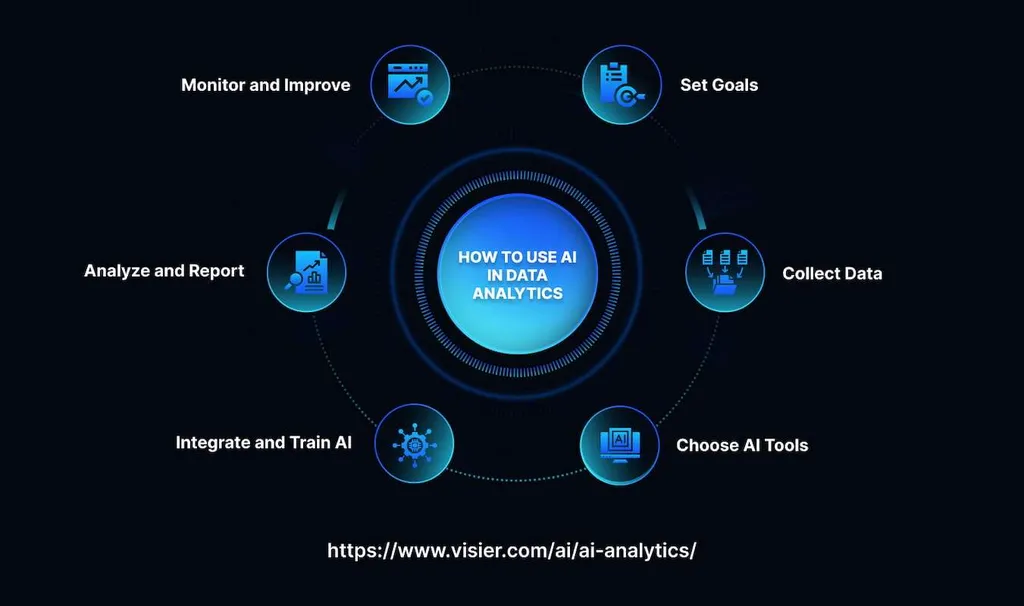
Businesses use AI to understand what problems they need to solve and select the most suitable LLM, depending on the primary cause of an issue. It permits them to save money in the long term and avoid wasting resources. Here are the key stages of the procedure:
- Preparation. Analysts gather necessary information from multiple sources, including third-party firms. Then, they pre-process insights and organize them to allow other tools to analyze them later. Double-checking data, without any duplicates or false records, facilitates building reliable AI models and achieving consistent results.
- Deployment. After assessing a model, a venture can integrate it with its legacy systems, dashboards, and APIs to improve its performance. Modern AI tools let companies generate summaries, visualize trends, and utilize statistics and ML to foresee new developments. While their implementation can be expensive, they help entities allocate resources better. AI systems use different types of algorithms to make weighted decisions. They consider goals, tradeoffs, and risks to estimate how an enterprise should react in various situations.
- Monitoring. Teams should constantly assess the functioning of their models, update them with features, refine them, and provide additional training to ensure they will adjust to all scenarios, regardless of their complexity.
AI data analytics enables firms to predict the changes and transform routines depending on the situation.
Benefits of Using AI for Data Analytics
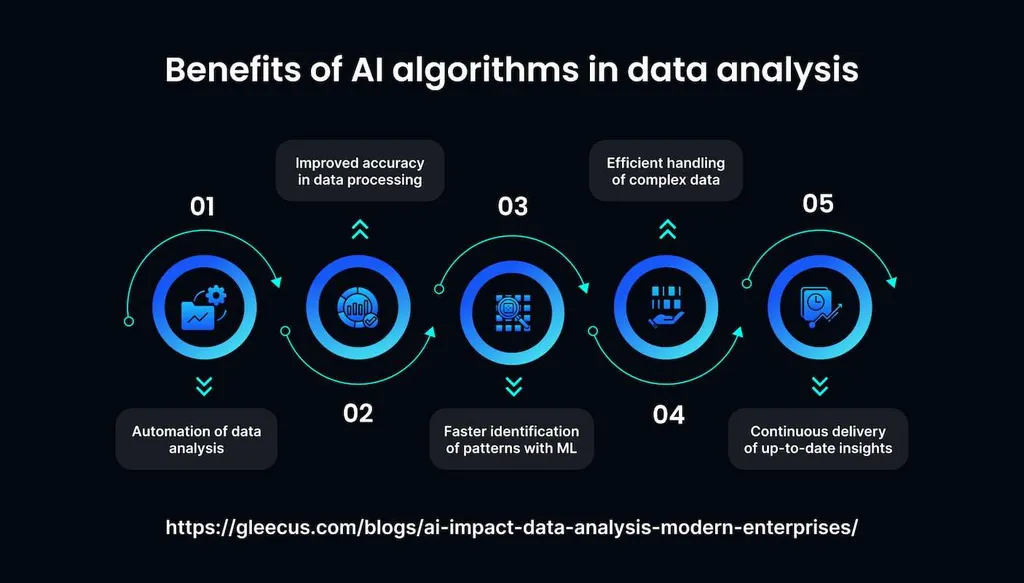
Building custom LLMs from scratch may be time-consuming and require a substantial investment. However, you can find a lot of ready-to-use solutions. There are several notable upsides to using AI to uncover trends with stunning accuracy:
- AI enables companies to diminish operational costs. Most businesses report that the implementation of AI has helped them save a lot of money. They no longer need to hire analysts to perform manual processing tasks. Algorithms process and interpret facts with impressive precision.
- AI saves time. AI models are built to process and organize insights quickly. They cope with assigned tasks faster than hired employees and provide updates in real time. In healthcare, finance, and other sectors, AI minimizes accidents, increases uptime, and streamlines maintenance.
- A powerful business intelligence tool is more accurate than human employees. There is no risk that they will omit specific information or mistype anything.
While the implementation of AI tools may be costly, it will bring tangible benefits to any venture or organization that intends to expand its presence, achieve sustainable growth, and outpace competitors.
Main Use Cases of Generative AI Data Analytics
When companies started to deploy AI to expedite their routines, they discovered new applications of algorithmic tools. Here are the most frequent situations where entities benefited from AI:
Writing code
LLM-powered tools generate the first version of code, which allows developers to reduce time to market and finalize projects faster. AI tools are hardly suitable for enhancing well-organized, advanced code. However, such templates are invaluable for teams that need to quickly access code snippets for all kinds of simple use cases. AI allows engineers to adapt legacy code and use it on modern websites quickly.
Building chatbots
Virtual assistants help entities streamline daily interactions with customers, win their support, and build brand loyalty. They process thousands of requests during peak hours in an automated mode without slowing down. Most customers nowadays prefer to receive instant replies when they contact CS teams. Answers generated by AI bots, like MetaDialog, increase client satisfaction and help brands to foster loyalty. LLMs facilitate developing powerful chatbots designed to process inputs, identify client needs, and suggest solutions to exceed customer expectations. Besides using chatbots to serve customers, businesses can also deploy them to show their employees how to process inputs more effectively. Many firms integrate AI bots with analytics platforms. AI data analytics allows employees to understand what different metrics mean and clarify questions about data. Staff members ask such bots to provide additional details and insights, which empowers them to use the centralized dashboard and write queries. Chatbots have powerful cognitive search capabilities, which allow them to explore datasets and extract relevant records without delays. Developers integrate them into workflows via API or as standalone apps.
Data governance
AI tools simplify the process of handling documentation and allow one to create metadata and track lineage automatically. Ventures use them to spend less time on routine tasks and adopt modern practices. AI helps one process documents faster and improve QA workflows. GenAI tools produce comprehensive documentation and highlight the areas that require improvement. They permit companies to achieve consistency when building ecosystems. The usage of AI enables entities to build trust. When a client or a stakeholder asks questions about analytical reports, generative AI tools provide all the references and clarifications they need to understand calculations, conclusions, and business guidelines.
Visualizations
Modern web-based services with in-built AI tools facilitate creating visualizations using chatbots. You just need to write a conversational prompt, and an AI app will generate infographics and other types of images that may appeal to your target audience. Agentic AI tools provide accurate summaries and explanations of visualized facts, making them especially suitable for developers who do not have extensive expertise in SQL and visualization.
Workflow optimization
Developers use cloud-based tools to optimize their routines and integrate AI data analytics into their applications and processes without advanced coding skills. This approach enables them to get summaries and generate reports automatically, without compromising security and privacy. Teams can utilize low-code services and API integrations to make collected information more accessible. AI solutions facilitate connecting systems with sources. It allows one to spend less time on performance reports, send professionally-written emails, and build powerful analytical apps with interactive functionality. Automated processes enable one to spend fewer resources on daily tasks, monitor metrics, create summaries with in-depth explanations, and use multiple channels to communicate with stakeholders.
Data cleaning
Well-organized sources enable firms to get more accurate insights. However, human employees might make mistakes when trying to create datasets manually. Preparing information for analysis takes a lot of time and effort. AI tools have demonstrated impressive efficiency at dealing with empty values or discovering outliers. Their usage helps analysts minimize errors and expedite workflows. AI data cleaning tools are in high demand, which explains why the industry is projected to grow to up to $7.1 billion by 2032. Organizations that rely on information need to invest in AI to obtain industry-relevant insights and make better decisions.
AI agents
These powerful tools have advanced reasoning skills, which make it easier to handle challenging analytical issues. They adapt to a changing environment and fine-tune their functioning based on previous tasks and projects. Several AI agents can work together within the same system. They break tasks down into several steps and distribute them among themselves to expedite project completion.
With the development of AI technology, other applications of AI data analytics will be discovered. Businesses deploy such tools to simplify workflows, adopt a structured approach to achieve consistency, and increase profits. They embrace a multi-agent approach to handle different use cases and increase the accuracy of their analysis.
Risks Associated With Analytical AI Tools
Many companies are still afraid of AI, as they worry that algorithmic tools may not be transparent enough. AI solutions use LLMs to generate responses. However, it might be challenging to see why they reached a certain conclusion. Besides issues with finding the basis of evidence, businesses need to consider the following:
- Security. Development teams should implement secure mechanisms to safeguard customer data and ensure that sensitive files won’t be accessed by unauthorized third parties. Such a diligent approach helps them maintain compliance and solve security issues.
- Accuracy. Widely used LLMs gather information from publicly available sources. If this information contains errors, they deliver responses with mistakes. Ventures need to use high-quality datasets to train LLMs and get consistent outputs.
- Cost. Building, training, and upgrading LLMs involves making substantial investments. Besides, companies may have to spend even higher sums to scale their operations. As AI tools constantly get upgraded, firms also have to invest in maintenance to keep their AI systems secure and fully functional.
Many businesses outsource the task of creating LLMs to reputable providers like MetaDialog, as it permits them to develop AI solutions with high response consistency at a lower cost. This approach is perfect for entities that do not want to hire teams of top-level developers with experience in algorithms. Entrusting dedicated professionals with building and integrating AI systems enables enterprises to save funds and scale processes with ease. This practice has proven its feasibility when it was embraced across many industries.
Final Thoughts
The deployment of AI data analytics tools helps businesses collect information via different communication channels and become more accessible. AI algorithms are perfect for B2B research, customer trend analysis, and other related tasks. Ventures adopt AI to make data-driven decisions and allocate resources wisely. Building an LLM is extremely challenging unless a firm has employees with the right expertise in this niche. Enterprises of all sizes are looking for reliable third-party service providers. MetaDialog has a team of talented developers who build custom LLMs designed in accordance with client requirements. We create AI models that streamline interactions with clients and allow businesses to reply to up to 81% of incoming questions automatically. Our AI assistants collect insights from multiple reliable sources, analyze them, and produce answers to fully answer customer requests. Contact our managers now and learn how to leverage AI to analyze data.