


The development of artificial intelligence (AI) has a positive effect on field service automation. It allows companies to reduce the number of repetitive tasks and optimize processes. Innovative AI tools dynamically process new data and generate more accurate outputs, helping businesses streamline field operations (FieldOps), use data about equipment, employee profiles, and resource usage, and adopt modern coaching and professional development practices. In this guide, we will explore the implementation of AI in field service management and consider whether algorithmic solutions can help managers simplify their routines.
What is AI in Field Service Management?
The usage of machine learning (ML) algorithms facilitates automating a company’s routines. AI lets managers spend less time on scheduling, routing, maintenance, and other tasks. They can assign tasks to employees, dispatch technicians without delays, and provide detailed information about job sites.
Field service AI facilitates making accurate assessments, detecting unfavorable developments, analyzing data tendencies, and solving problems proactively, before they manifest and cause damage. Efficient maintenance practices improve client satisfaction, reduce downtime, and minimize repair expenses. Technicians can especially benefit from the use of AI. Field service augmented reality (AR) solutions enable them to use digital data and manuals more effectively when working on physical objects and equipment. It allows them to optimize diagnostic processes and fix issues quickly.
Technicians and mobile workers use AI to spend less time on daily tasks and avoid distractions. It enables them to focus on the projects that bring higher value. Companies utilize AI agents to provide 24/7 support and make their services more affordable and client-centric. Automation permits firms to reduce time spent on low-value tasks and allocate resources wisely to achieve sustainable growth.
Why is Field Service AI Important?
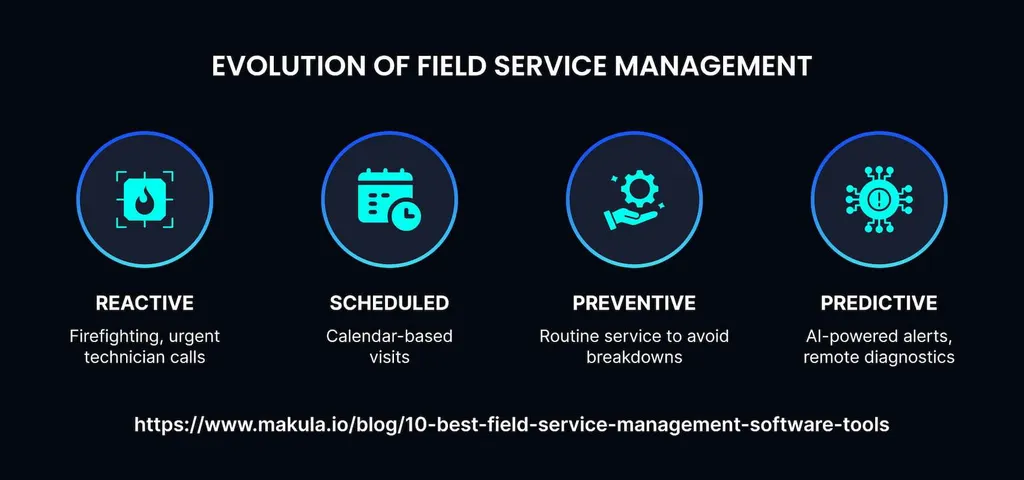
Managers, clients, and support technicians can equally benefit from using AI for FieldOps. This approach makes it easier to understand current processes, maintain visibility, and get real-time updates. It facilitates making the right decisions and upgrading processes to achieve higher workflow efficiency. Automated tools enable employees to create better technician schedules, optimize routes, and reduce travel and delivery time. AI features have predictive analytics capabilities. Relying on them, staff members discover new ways of maintaining equipment in the right condition and mitigating the risk of downtime.
Convenient dashboards with AI-driven tools enable managers to track important performance indicators, detect emerging trends, analyze progress, and augment service delivery.
Mobile workers use AI to access accurate information in real time, receive expert guidance, and improve workflow efficiency.
Technicians work faster when using detailed repair guidelines and can get expert advice using AR tools. It facilitates issue diagnosis and helps minimize the time spent on each task. Enterprises deploy AI to provide high-quality maintenance and repair services.
Companies use customer service AI tools to provide personalized support and deliver more accurate responses without delays. Due to the implementation of predictive maintenance solutions, clients experience fewer equipment breakdowns. Real-time tracking and scheduling facilitate reducing response times. AI diagnostics tools improve fix rates and reduce the number of repeat visits.
Clients expect ventures to implement CS automation systems and provide 24/7 assistance. Dedicated AI scheduling agents process customer requests and choose an employee with the right technical skills for the task.
Benefits of AI in Field Service Management
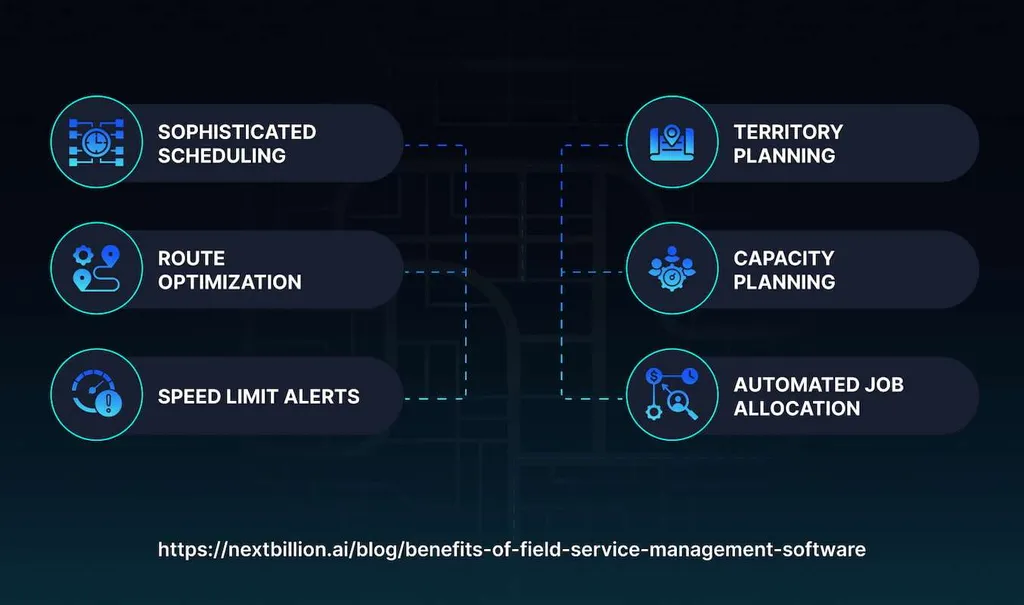
Ventures utilize AI to expedite routines, improve resource allocation, and achieve growth goals. Here are the key upsides to implementing algorithmic solutions.
- Higher efficiency. AI enables firms to streamline technician logistics and improve their schedules to minimize travel times and increase job satisfaction. It facilitates asset monitoring, allows one to get quick recommendations regarding maintenance, and reduces equipment downtime.
- Asset service management. Employees can track the performance of various tools using sensor data. In-depth analysis of past patterns facilitates scheduling maintenance sessions and allocating resources wisely.
- Step-by-step guidance. Visual remote assistants help technicians handle on-site tasks more quickly, enhancing the client experience.
- Time-saving innovations. Artificial intelligence field service tools speed up resolution time, enabling technicians to spend less time on routine tasks.
- Reduced expenses. AI automation optimizes travel time and operational costs.
- Personalization. As more customers expect companies to focus on their needs, firms use AI to tailor services to the preferences of their target audience.
Technician who use AI in field service management improve their productivity and learn how to diagnose problems more quickly. It allows them to improve the fix rates and minimize callbacks. Companies use customer and asset data to provide personalized support, manage inventories effectively, and expedite scheduling.
Features of Field Service AI
AI solutions are equipped with handy tools, enabling businesses to perform a variety of work-related tasks. Here are the key functionalities of AI for Field Ops:
- Route optimization for technicians. Firms create improved routes based on job site locations, traffic, and task priorities.
- Dispatch management. AI enables managers to quickly adjust employees’ schedules after unexpected cancellations or other changes. Such tools provide tips to ensure every task is handled promptly by a professional with the right skill set.
- Maintenance. AI features predict equipment issues and make timely interventions possible.
- Analysis tools. Employees deploy them to detect usage patterns and predict changes in demand. Technicians can check whether they have the required parts and assets. Besides, it allows employees to follow the conditions stipulated in the service level agreement (SLA). AI bots can quickly provide information about warranty terms and asset usage history.
- AR tools. They enable professionals to assist field service engineers remotely.
In addition, AI bots may recommend urgent upgrades and suggest equipment replacement based on the collected client data. It facilitated upselling and cross-selling. AI solutions also create briefs to guide workers on the projects they are tasked with.
Main Applications
Major companies have already started to integrate autonomous field service solutions. Across many industries, such tools bring tangible benefits. Here one some of the key use cases to consider:
- Streamlined auto club operations. A top firm servicing 6 million roadside events per year started to utilize AI tools to generate pre-work briefs. It allows employees to spend 5 minutes less on each case, which saves the company over 30M minutes annually. Furthermore, the staff members use AI to upsell battery replacements and expedite stock replenishment.
- Improved performance of a heavy equipment business. The company had issues when trying to communicate with technicians dispatched in the field. AI-generated briefs helped employees to start solving problems more quickly after arriving on-site.
- Optimized routines of a water system installation firm. After implementing on-site knowledge search tools, the venture reduced onboarding time and scaled up its processes.
As AI becomes more advanced, new use cases will emerge, helping ventures deliver better services and handle complex tasks with ease.
How to Implement AI in Field Service
Ventures have adopted a set of time-tested practices that allow them to scale up by deploying AI in field service management. One should follow these simple steps to transform their routines:
- Discover the areas that require improvement. Focus on tasks that can be automated. Prioritize route optimization, maintenance, and scheduling to achieve higher ROI.
- Take a small step at a time. Launching a pilot project will enable you to streamline access to knowledge bases and ensure technicians have the resources and data they need. Some AI bots have extensive summarization capabilities and provide information helping staffers to achieve higher first-time fix rates. They increase the value of the services provided by a company and facilitate building a strong reputation.
- Focus on data quality. Accurate and well-organized information improves algorithms’ accuracy. Dedicated cloud-based software with extensive data storage and analytics tools permits businesses to achieve higher scalability.
- Train staff members. Field service teams should learn how to use AI features to their maximum benefit.
Ventures must focus on continuous improvement and use KPIs to measure progress. It will permit them to keep AI systems effective.
Field Service AI Trends
Organizations can tap into the full potential of AI if they focus on the latest developments in the technology. The proactive approach helps them remain ahead of the curve and discover how to augment their routines. Here are some things to keep your tabs on:
- Wearable technology. Mobile workers utilize AR apps to simplify their routines. They may use the Apple Vision Pro headsets, smart glasses, and other tools to get the guidance they need.
- AI agents. Advanced algorithmic systems integrate real-time information, communicate with customers via multiple channels, provide centralized access to knowledge bases, and predict potential cases of equipment failure.
Many businesses have already implemented AI agents, seeing them as an opportunity to streamline processes, reduce resource waste, and deliver high-quality services to customers.
How to Use AI in Field Service to Improve Operations
Whether you are interested in asset maintenance, repair session scheduling, or customer service automation, AI tools will help you cope with every task. Modern systems consider a variety of factors when choosing technicians most suitable for a project. AI collects data in real time, analyzes it, and provides detailed summaries, enabling workers to shorten the resolution time and enhance the quality of their assistance.
Use the following tips to make the most out of automated features:
- Integrate AI systems with regularly updated databases. It will help technicians access quick insights on mobile devices, provide informed responses, and analyze the situation more effectively.
- Implement predictive maintenance systems. Use IoT sensors to collect data and fix problems before they cause critical damage or extended downtime. As a result, technicians will handle fewer emergency calls.
When the lifetime of equipment increases, it will enable you to spend less on replacements. If mobile workers have the right tools and parts at hand, their service visits will become more effective.
Final Thoughts
Using AI in field service management lets companies implement automated scheduling solutions and perform more tasks faster. Mobile workers spend less time traveling between different job sites and receive AI-produced summaries to handle any issue quickly. Before integrating new technologies, consider your firm’s current objectives. You should have the right tech stack and trained employees to succeed. While some ventures prefer to build custom AI systems from scratch, others outsource this task to reputable providers and adjust AI solutions depending on the industry’s requirements. MetaDialog builds advanced AI models and CS platforms to help clients reduce the average resolution time to 20 seconds. Get in touch with our team today and discover how to integrate AI in your workflow to simplify FieldOps.