


The insurance industry has traditionally followed a set of commonly accepted rules that have not changed much. However, nowadays, it has become more client-oriented and has started to adopt the newest technologies into its workflows. In this guide, we will examine the importance of AI agents for insurance and discover how companies integrate them into their workflows. Businesses that quickly recognize the potential benefits of deploying algorithmic solutions can use LLMs to gain a competitive edge.
What Are AI Agents for Insurance?
The term describes digital assistants that provide guidance to clients, consulting them on available services and simplifying client-organization interactions. The AI enables the development of powerful virtual assistants trained on extensive datasets. They are designed to work autonomously 24/7 and make weighted decisions based on in-depth analysis of the available data.
Many insurance organizations use automation systems built to function in pre-defined operational conditions. However, the usage of AI in insurance allows them to expand the functionality of their software and deploy AI bots capable of learning. Such solutions analyze the situation, interpret inputs accurately, enhance their performance over time, and choose the best course of action to achieve the desired goals.
Here are the main capabilities of AI agents for insurance:
- Assessing the environment. Bots analyze changing data to better understand price fluctuations and client preferences.
- Formulating a response. After detecting trends, AI bots identify steps that might drive positive changes in a company’s processes and increase profits.
- Reasoning. AI solutions search through large datasets to discover patterns and extract useful insights. It facilitates making the right decisions.
- Solving issues. Virtual agents address issues of varying levels of complexity. They can process claims, send payment reminders, alert human investigators to potential fraud, develop efficient marketing strategies, and perform other tasks.
- Learning. AI models analyze historical and current data to predict future trends. Their forecasting capabilities become more accurate after processing new data inputs.
- Analyzing potential scenarios. The AI compares likely outcomes and develops strategies to help an organization optimize its operations.
Most modern AI agents possess these capabilities, making them indispensable for companies seeking to improve their outcomes and achieve sustainable growth.
The Benefits of AI Agents for Insurance
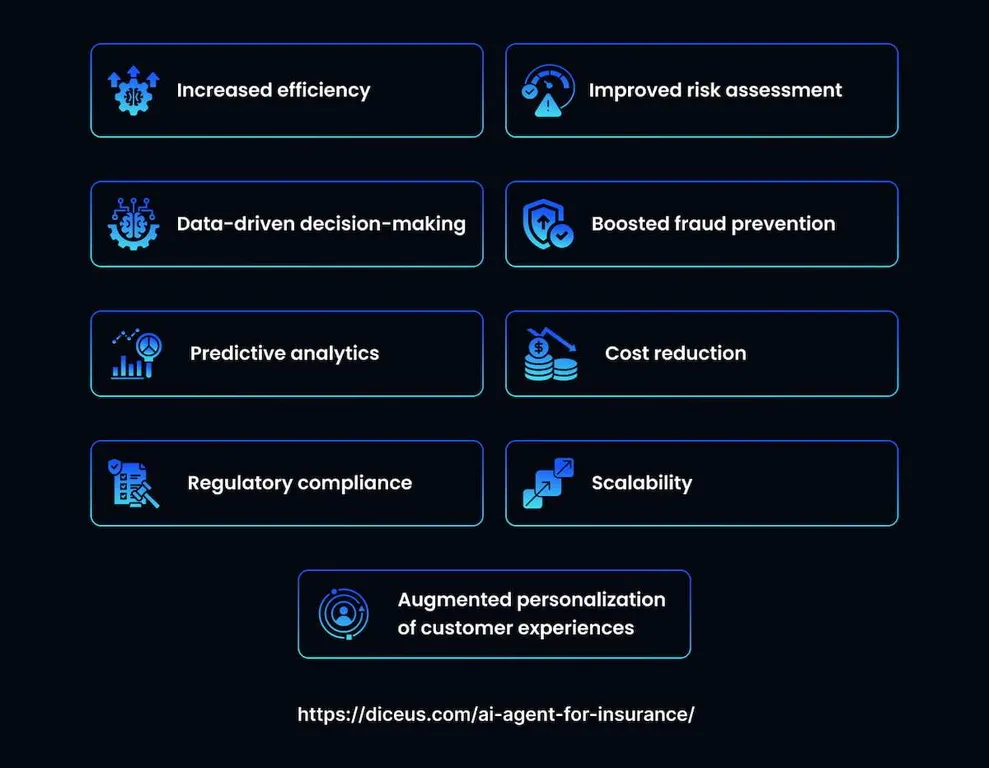
Building a resilient IT infrastructure necessitates deploying AI bots. Below, we have briefly outlined the main upsides of relying on the AI:
- Higher efficiency. Companies automate repetitive tasks to free up employees and ensure they have more time to focus on advanced projects. Bots are trained to perform data entry, handle documents, and answer customer queries. The most advanced solutions specialize in insurance underwriting and other complex tasks.
- Accurate risk evaluation. The AI is capable of searching through massive sets of structured and unstructured data, discovering patterns, and detecting factors behind emerging issues. Bots can easily replace a team of human data analysts. They can choose premium pricing and diminish the number of underwriting mistakes.
- Better decision-making. AI agents provide recommendations based on their in-depth analysis of the current situation and historical data. They collect information from multiple reliable sources and produce detailed reports to help stakeholders come to the right conclusions. It allows them to improve every stage of the standard insurance workflow, from claims management to client acquisition.
- Increased safety. AI agents are based on complex algorithms. They are trained to detect early signs of fraud and prevent suspicious activities. By deploying them, insurance companies can diminish financial losses and ensure nobody gets a chance to exploit the system using unfair methods.
- Predictive analytics. AI solutions stand out for their ability to forecast future developments. They extract valuable insights, helping insurers choose the right strategies, adjust pricing, and change policies to achieve higher profits.
- Lower costs. An insurance agency needs to minimize the possibility of fraud and automate daily tasks to reduce operational expenses. AI assistants help companies save time on customer support and provide top-level services to clients to ensure higher satisfaction.
- Regulatory compliance. As legal frameworks change all the time, it makes sense to deploy AI to track updates and apply changes across all processes. AI bots make a firm’s practices transparent and facilitate auditing. Using them enables insurance companies avoid being hit with non-compliance fines.
- Scalability. The AI facilitates expanding a firm’s presence in new markets without significant investments. AI agents process higher volumes of requests during peak times, browse extensive datasets, and enable businesses to scale their operations without increasing headcount.
- Improved customer experience. These days, most clients prefer to order services from companies that use AI-powered personalization. The AI can provide tailored recommendations that meet the needs of the target audience. Besides, bots may adjust pricing to make offers more appealing. Their deployment facilitates upselling and enables businesses to build loyalty.
Artificial intelligence is expected to transform the insurance industry in the coming years. Let’s consider how it can make companies more efficient and client-oriented.
The Future of AI Agents for Insurance
With the development of new technologies, AI agents will become even more powerful. Their extensive capabilities allow them to solve advanced tasks automatically, provide accurate insights, and take the necessary steps to address issues that may compromise clients’ safety. Insurers also use them to boost engagement by augmenting customer experience and making it more personalized.
Broad adoption of AI will lead to widespread deployment of AI agents. Companies are expected to start implementing smarter and more complex self-service systems to handle clients’ requests 24/7. The integration of tools with extensive GenAI capabilities and AI personalization will help insurers outpace competitors and solidify their market position.
Organizations should be quick to adapt to upcoming changes and avoid technologies that hinder growth. The usage of high-quality data streamlines LLM training and helps businesses remain fully compliant. Insurers deploy solutions that have already been successfully tested by the banking industry to augment clients’ safety.
The AI has transformed the preferences of individuals who typically order insurance services. It allows agencies to improve every step of the consumer journey and communicate with clients across multiple channels. In the coming years, more companies will start using AI to attract and retain clients with on-demand offerings and analyze their needs to deliver personalized service packages.
The best insurance companies will use AI to analyze underlying risks, process unstructured data, and provide empathetic replies. It will allow them to automate complex routines and increase returns. Hyper-personalization leads to higher sales and improved claim management.
How to Use AI Agents in the Insurance Industry
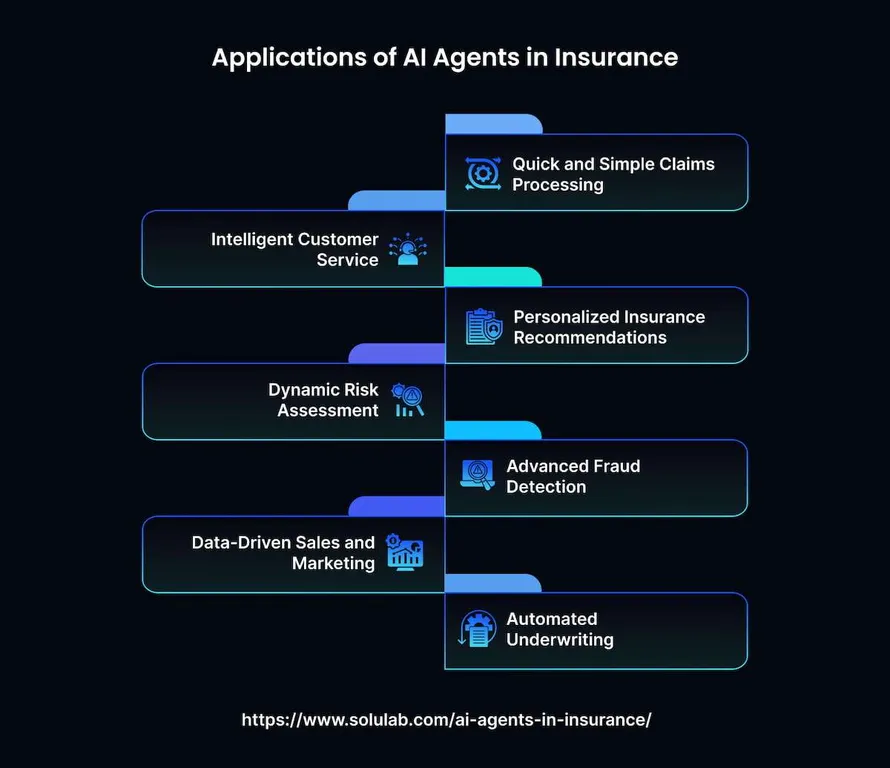
Building AI tools and integrating them with existing systems requires technical knowledge and understanding of the processes that require improvement. Below, we have briefly described the main applications of AI bots by insurers:
- Claims processing. Such tasks consume a lot of time and effort if done manually. However, AI agents significantly simplify them, as they are trained to automate everything, from FNOL to settlement. They verify policies, generate documents, and streamline adjudication. Firms deploy them to automate claim tracking, reduce resolution times, and eliminate the need for manual intervention.
- Fraud detection. The AI establishes safeguards and recognizes suspicious activities.
- Customer support. Virtual agents provide full-time assistance and increase omnichannel customer engagement.
- AI underwriting. AI bots process organized and raw data and use predictive analytics to adjust prices and maintain a fair approach.
The AI solutions process claims. They also expedite onboarding, evaluate risks, and analyze all the available information to adjust coverage prices.
Final Thoughts
Making the most out of the AI requires changing the way insurers handle key processes. The integration of AI-powered voice agents will ensure higher accuracy of underwriting. Companies need to embed AI in every workflow and adopt new operational models to leverage the modern tech stack. The usage of AI agents for insurance requires relying on complex models. MetaDialog builds advanced LLMs to power modern CS solutions and help insurers handle requests, process claims, and optimize routines. Get in touch with our team to integrate AI into your business model.